Showing posts with label historical place. Show all posts

Sunday, June 23, 2024

Bruges- Belgium Travel Journal part-2


Bruges is one of Europe’s best-preserved cities. This is evidenced by its historic city centre, the entirety of which has been designated a UNESCO world heritage site. The historic centre of Bruges is compact and easily walkable. Even with only one day in Bruges, we managed to see and do everything we came here to experience. Here are some of the main tourist attractions in Bruges that we saw during our self-guided walking tour of Bruges’ The Old Town. 


Bruges, a charming city in Belgium, captured our hearts with its enchanting canals, cobblestone streets, inspiring architecture are almost awfully picturesque and of course, mouth-watering Belgian waffles.


French fries (called Vlaamse frites, or “Flemish fries,” for the region of Flanders, in which Bruges lies) are another guilty local pleasure.

It was so fun to just wander around and take in all of the details. Bruges is a tourist hotspot so the crowds can be thick and there are always. We’ll explore into the history of Bruges, wander the streets, and experience the delights of this enchanting European destination. 

After a short walk, we found ourselves in the heart of Bruges, ready to explore its cobblestone streets and unravel its history. The city’s well-preserved medieval architecture took us back in time. As we strolled along the winding roads, we admired the ornate facades, gabled houses, and towering belfries. Each corner revealed a new architectural gem, telling stories of Bruges’ prosperous past as a bustling trading center.

Burg (Burg Square)

The Market Square is the heart of Bruges, but the Burg Square is its soul. For centuries this has been the centre of power in the city, and Bruges’ city administration still occupies the 14th century Gothic Town Hall. This grand, majestic square is lined with monumental landmark buildings. These were built over the centuries, and reflect the building style of their age. A handy architectural guide assembled in a single square!


Although the Burg Square is actually packed with highlights. Over the centuries, several majestic buildings have been constructed, each in the prevailing architectural style of the moment. Bruges history in an abundance of historical objects: majestic tapestries, colourful glass windows, elegant wood sculptures, historical lace, Burgundian manuscripts, etc. Each tells a particular Bruges story.


There are lots of ways to explore Bruges and you won’t be disappointed if you try to see the city by foot. But for something a bit special, perhaps you could try a ride in a horse-drawn carriage. Still, their presence contributed to the overall charm of the Market. Horse drawn carriages wait in the square for tourist to whisk around Bruges. Carriage tours start and end at the Market Square. I enjoyed the rhythmic clopping of horse’s hooves.

Canals of Bruges

These small canals, overlaid by historic arch bridges, are typical of the city’s character. At the end of this cobblestone road.


The canals have for centuries been the veins of the city, winding through Bruges and treating you to another magnificent view around every bend. Take a stroll or a boat trip and discover secret gardens, romantic bridges and medieval facades reflected in the water.

Canal cruise of the medieval city


A Bruges itinerary would not be complete without allowing time for a canal cruise. A Canal tour, which was a fantastic way to immerse ourselves in the city’s charm. Bruges boasts an intricate network of canals, earning it the nickname “Venice of the North.” Gliding through the waterways, we marveled at medieval buildings, picturesque bridges, and idyllic scenery. 


And while we were in a boat full of other people, it was still a peaceful and enchanting experience that allowed us to view the city from a whole new perspective.


In Bruges, it means you’ll cruise past the oldest wooden buildings in this medieval city as well as learn more about various buildings and landmarks from the local guide on board. I loved the canal cruise because we passed by a lot of very beautiful buildings and the pretty Rozenhoedkaai, saw some swans gracefully floating .


Bruges crafts some of the most luxurious lace in the world. 


Pop into one of the lace shops dotted around the city to buy a lace souvenir, or better yet visit the Lace Centre to learn more about the history of lace in Bruges.

One of Bruges’ most attractions is the windmills. A windmill located in the city of Bruges .We explored into the history of Bruges, wander the streets, and experience the delights of this enchanting European destination.  


Stunningly picturesque Bruges, in the Flanders region of Belgium,


 is often hailed as one of Europe's best-preserved medieval cities. Bruges is one of the best preserved medieval towns in Europe. 


Many of the buildings date back to the 13th and 14th centuries, including the impressive Belfry in Market Square. Walking through the medieval cobblestone meandering canals, , and historic architecture making it a destination that seems to have been plucked straight from a fairy tale. feels like stepping back in time and it is an incredible place to visit.

Sunday, December 26, 2021

Venkatachalapathy Temple-Krishnapuram


We both belong to Tirunelveli Dist. Tirunelveli is a place that is worth a visit at least once in the lifetime. There are many places in Tirunelveli that attract many tourists towards the place. Some of them include dams, temples, sanctuaries, sculpture houses, waterfalls, and hills and so on. Apart from the places there food and tradition of this place are very rich and unique.

Tirunelveli's history dates back to 2000 year ago, and thus, the city is inarguably one of the best places to trace the stories of various dynasties and its legends.Whenver we came to our home  town we visit all temples and waterfalls etc. In our last visit we visited Venkatachalapathy temple.


Krishnapuram is a small temple village near Tirunelveli, The village is home to the Venkatachalapathy Temple, another grand architectural marvel Located about 7 kms from Tirunelveli city on the way to Tiruchendur Murugan temple. One of the best architecture temple in southern India. This temple devoted to Venkatachalapathy is having a sprawling complex containing a big prakaram for cirambulation


Here lies Sri Venkatachalapathy temple built by Sadasiva Devaraya in 9th century and extended by Naicker rulers two centuries later. During the Madurai Nayaka period. Inscriptions say the temple was built by Krishnappa Nayak, after whom the place is named. The temple is spread over an area of 1.8 acres. Originally, the temple had three praharams, built from solid granite.


 But the outermost praharam was demolished by an Izlamic general Chanda Sahib at the orders of Nawab of Arcot.

The principal shrine, fronted by a five-tier Rajagopuram is flanked by two simpler sub-shrines, to goddesses Alamelumanga and Padmavathi. They are both in seated posture. The main deity, Venkatachalapathy, is four-armed, standing and with the ubhaya nachiyars. Lord in Bogasthanam is with his consorts Sri Devi and Bhoodevi. The stoopas, shilpas though centuries old depict the carvers mind and the realities of the times with writings of 9th century visible.


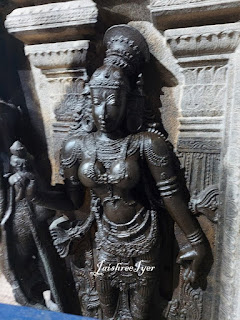
There is a corridor before entering the main temple which has gigantic 15-20 feet bronze statues which is the highlight of the temple. The statues are so intricate inside staring on one side of the pillar and literally curving to the other side. there are 42 such statutes in one hall alone. Unfortunately it was very dark inside and we could hardly make out the beautiful statues without a good torch/flashlight.

In the outer corridor we can see statues (protected by steel mesh) as follows on entering to our right starting with


1) A Nomad in dancing pose,


2) A gypsy woman kidnapping a Prince on her shoulder (as per the tamil writing above the statue), On the same pillar we see a horseman with the legs of the horse on a person kneeling down.

3) Karna in a majestic standing posture. On the same pillar we have a smaller statue behind Karna


4) There is a beautiful Murti of KuravanA gypsy man kidnapping a Princess on his shoulder(as per the tamil writing above the statue).The grace in his stance has to be seen to be believed. The shilpi has caught him mid-motion. The Murti does not look status. It looks like he is going to complete the movement any moment. We can notice his ribs, the curve of his calves, the place where his hair bun bears the indent of the princess’s fingers, as she steadies herself. On either sides of the man we see a man on a horse and 2 smaller figures of men holding on to the gypsy as to preventing him from kidnapping. 

5) A statue of Arjuna with his bow in standing pose,


6) Another Statue of Nomad where astounding scuptures that are life size over five and a half feet, Nerves are seen in the human forms, All these sculptures were made from a single Granite stone,In one statue, a leg, extended into air is two and a half feet , it projects from the torso and this sculpture is also made of single stone.

In the statue of Manmatha (God of Love) , a Bow of Sugar Cane, which is his weapon is found. The bow, with its curved structure stands about five feet tall.


 In the Statute of Rathi, consort of Manmatha, one can find her cheeks puffed up swallowing Thamboola!  Her hairstyle and jewellery are exquisite. The Shilpi has carved her fingers with gap between them as she artistically holds a mirror. All this is done in one single block of granite!

There is a larger than life Murti of Arjun, the warrior. You can see the bamboo grooves of his bow, the proud half-smile on his face, his armour and his warrior like stance

An elephant and a Cow


The other fascinating sculpture here is that of two animals made out of one stone. As one looks from the left, one sees an elephant lifting its tusk. From the other side, though, this same image shows us a cow- truly a terrific piece of art.


When we visited this temple there is no visitors. Only we saw priest in sanctorum  and we workers cleaning the temple. Feel sad that such a heritage temple has to well maintained and lot of tourist must visit the place to see Lord and ancient culture and sculpture.  Sadly, the temple has ugly iron railings that are supposed ‘protect’ the Murtis, but serve as an eyesore! I really wish Hindu temples were managed better. Our ancestors went to great trouble to carve such exquisite Murtis, the least we can do is to look after them. Please visit Krishnapuram if you can.

I clicked few pictures with temple permission.