Showing posts with label History. Show all posts

Monday, May 18, 2015

SunTemple at Modhera (Gujarat)

The Sun Temple of Modhera is located at Modhera in Gujarat. Modhera Sun Temple is famous for its architecture. It Temple was built by King Bhimdev of Solanki Dynasty in 1026. Solankis were known as suryavanshi. This temple is known as 11th century sun temple. 
 
This temple is designed as first ray of the sun fell on the image of sun. Modhera's sun Temple's architecture is similar to the Konark Sun Temple.The Sun temple is a unique architecture and has three separate, axially aligned and integrated elements: Surya Kund, Sabha Mandap and Guda Mandap.
 
The structure comprises of intricate carvings and designs that brighten up the temple at dawn when the first rays of the sun hits the area. The intricate designs of the Solanki architecture are perfect to every minute detail and reflect rare craftsmanship. The exclusively carved temple complex and the magnificently sculpted kund are jewels in the art of masonry of the Solanki period apparently which was also known as the Golden Age of Gujarat.
 
The Surya Kund is the first of three distinct components of the temple complex. To the west lies the Sabha Mandap or primary hall and beyond is the main temple — all laid out as on an east-west grid. The temple complex, which is built on the Tropic of Cancer, is designed such that the first rays of the sun fall on the main idol at the time of the equinoxes. The entire temple is based on a lotus-base plinth, lotus being the Sun God's favourite flower. It is designed in such a manner that the rays of the rising and setting sun on the days of equinox directly falls on to the pure gold idol of Sun riding on his chariot driven by Saarthi (chariot driver) Arun. The Sun God's chariot has seven horses and his saarathy sits on the fourth.
 
 The northern side of the tank and make our way to the centre of the western edge. Steps lead up to the Sabha Mandap, an octagonal hall between the water tank and the main temple. At the top of the steps are the remnants of a huge arch or Toran that lead to the main hall, the Sabha Mandap. There are 52 pillars in the hall, denoting the 52 weeks in a year.
 
Every pillar, including the Toran, is intricately carved. Starting with a simple octagonal base that showcases a small deity set in an arch on each face, the pillars are formed of geometrical patterns surmounted by exquisitely carved dancing nymphs, above which octagonal panels display scenes from the Ramayana and the Mahabharata.
 
 At the centre of the hall is an arched ceiling carved like an inverted lotus flower. The detailing is marvellous. Beyond the Sabha Mandap is the main temple or the Guda Mandap, which is no longer used. The absence of the main idol —believed to be a golden Surya on his chariot, in no way detracts from its beauty. 
 
The exterior walls of the temple are replete with carvings — including twelve postures of Aditya or the Sun god. Like many other temples in India, the walls depict divine as well as the daily lives of people, including a good deal of beautiful sculptures.


 The temple complex is being well maintained by the ASI, with some renovations done in recent times. For the historically inclined, the onsite museum has numerous sculptures and other stone work on display.
 
The 52 pillars adding grace and poise to the temple section. each panel in turn and witness the intricate details encompassing thepanels speaking and sharing about their costumes, jewelry, performing arts, erotica and the intensely enigmatic art of making love, medicinal plants, and the pharmacopoeia etched in stone.
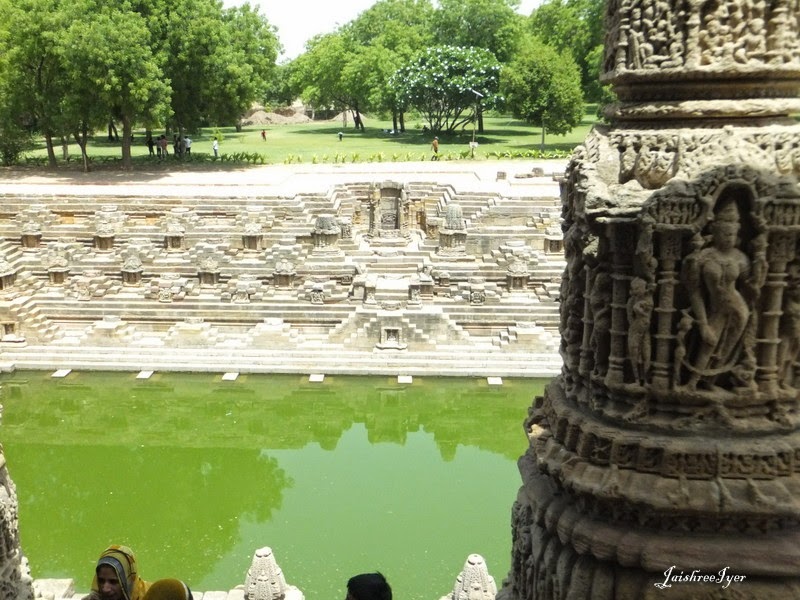
 
Suryakunda, also known as Ramakunda, is a rectangular stepped tank that is used to store pure water. Devotees use the tank to perform Surya namaskar and other ceremonial ablution before worshipping the sun god. It is one of the best visible examples of the designers' sense of geometry. 
 
Besides comprising a series of stone steps that culminate into the fresh water, the structure also embodies 108 miniature shrines carved in between these steps. The 108 shrines are synonymous to the 108 beads of the Hindu rosary. 
 
This is called the main temple or the sanctum sanctorum. The entry to the temple is decorated by two huge ornamental arches. Another notable work of marvel is the sculpted exteriors. 
 
The exteriors are decked with 12 different postures of Adityas - Sun God along with eight Dikpals, Lord Vishwakarma - who constructed Golden Dwarka city for Shri Krishna, Varundev - God of Water, Agnidev - God of Fire, Ganesh - God for starting, Mata Saraswati - Goddess of Education & Wisdom. The sculptures also depict erotic art that was typical of Hindu, Jain and Buddhist architectures.
 
Overall it was an eye opener on many things about our culture, scientific knowledge etc. It actually mesmerises you by the tech know that our ancestors had, precise calculations,impossible viewing angles defying the line of light. Its techno historic marvel. 
 

The place is neat and quite well maintained. Some of the carvings are amazing. The historical stories about the temple are very interesting. There is a lake in pond in front and a lovely garden all around and also a museum if one has the time. Definitely worth visiting.

Friday, January 4, 2013

Thirumalai Nayakkar Palace - Madurai Trip


Thirumalai Nayakkar Palace
I was born in Madurai and have spent most of my childhood in this city. Madurai is One of South India's great temple towns. I visited Madurai last week after three decades; when I visited Thirumalai Nayakkar Palace;I recalled my childhood memories.My home and my school was near to Palace. We friends use to often visit this Palace.
Thirumalai Nayakkar

 
Thirumalai Nayakkar Palace is a notable Indo-Western architectural masterpiece in Madurai. This Palace Built by King Thirumalai Nayak /Nayakkar in around 1636.

 
The Nayaks of Madurai ruled this former Kingdom from 1545 till 1740’s and Thirumalai Nayak (1623-1659) was one of their greatest kings that line notable for various buildings in and around Madurai. During the 17th centuries. Thirumalai Nayak ruled Madurai between 1623 to 1659 CE. He was a great patron of art and architecture and the Dravidian architecture evolved into the Madurai style.
History of the Nayakas:
In the 14th century, Madurai aroused the cupidity of Malikkafur who invaded it and set up a Mohammadan dynasty that remained in power for nearly fifty years, at the end of which it was conquered by a General of the Vijayanagar Empire and became a feudatory. The Vijayanagar Emperor, while guarding the kingdom against the invaders, subsequently restored it to the descendants of the Pandyan kings.

 
When Krishna Devaraya was the King of Vijayanagar, he sent one general Nagama Naick to Madurai to control the internal confusion in the Madurai regional politics. Nagama Naik controlled the warring groups and restored peace, but declared himself as an independent ruler. This act provoked the King Krishna Devaraya and he sent Viswanatha Naick, the son of the revolutionary Nagama, to arrest and produce his father in the royal court. Viswanatha fulfilled the order of the King, but justified his father's act and explained the real condition of the region. King, being convinced by the explanation of Viswanatha, released his father and crowned Viswanatha as the ruler of Madurai as a reward to his loyalty. Thus the Madurai Naik Principality was established about 1530 A.D.

 
From the middle of the 16th century, right up to the eighth decade of the 18th century. The city retained its glory as the principal seat of the Nayakas. Although Vishwanatha Nayaka, the first and greatest of a long line of distinguished rulers, is credited with having laid the foundations of a well planned and well fortified city. Tirumala Nayaka, who ascended to throne in 1623 A.D., and ruled over Madurai for 36 years can be said to have made the largest single contribution towards the enhancement of the beauty and splendour of the town by magnificent edifices and monuments.

Thirumalai Nayak Palace History:
 
Thirumalai Nayak constructed this palace in 1636 with the help of an Italian architect who visited Madurai around that time. Thirumalai Nayak (1623-1659) was one of their greatest kings that line notable for various buildings in and around Madurai. During the 17th centuries the Madurai Kingdom had Portuguese, Dutch and other Europeans as traders, missionaries and visiting travelers. Tirumala Nayak is believed to have recruited the services of an Italian architect, for the construction of his Palace. The king and the Nayak Prime Minister Arya Natha Mudaliyar was instrumental in restoration of other architectural monuments in the city like the Meenakshi Amman Temple, the Thirupparamkundram Temple and the Mariamman Teppakulam (water tank). As the abode of the king, the palace participated in activities in and around Madurai ,Over a span of 400 years many parts of the buildings were suffered much by time, and not inconsiderably... by the destructive effects of war; a few, however, are sufficiently in repair to be converted into use by the garrison, as granaries, store-houses, powder magazines during time of East India Company.


Thirumalai Nayak Palace Architecture:
 
The palace is the place where Thirumalai Naicker lived and held his court. The palace complex area was originally four times bigger than it is now, consisting of two portions – Swarga vilasa and Ranga vilasa. The spacious rectangular courtyard called the swarga Vilasam and a few adjoining buildings survive, their awesome scale evoking the grandeur of a vanished era. Upon entering into the gates of the palace, the visitor enters into present day’s huge central courtyard measuring 3,700 m² (41,979 sq ft). The courtyard is surrounded by massive circular pillars. A view of the interior of the palace, with an arcade of columns enriched with foliated brick arches. Behind this are cloisters carved in triple rows of columns..To its west lies the Throne Chamber, a vast room with a raised, octagonal dome. This room leads to the Dance Hall. There were also other portions like the palace shrine, harem, theater, royal band stand, armory and other structures which were used to accommodate palanquins, royal chariots, relatives, servants, guests and other regal paraphernalia. . One of the domes stands without the support of girder -an architectural feat of everlasting wonder.
 

This expansive and open courtyard area is flanked by huge white circular pillars on all four sides. The Courtyard and the Dance Hall are the major attractions of the palace. The Swarga Vilasa or celestial pavilion was used as the throne room (arcaded by an octagon dome 60-70 feet high) while the Dance Hall was used for dance, music and other entertainment activities by the royalty. 
 
The domed structure in the centre is supported by stone ribs and is held up by massive circular columns topped and linked by pointed scalloped arches with an arcaded gallery opening into the nave above the side aisles.
 
The pillars supporting the arches are 13m tall and are again joined by foliated brickwork that carries a valance and an entablature rising up to a height of 20 m. The decoration is done, (shell lime). The pavilions topped with finials that were covered with gold are on either side of the courtyard. During 19th century, Lord Napier, governor of Madras between 1866 and 1872 made several renovation works. Then the palace was utilized to house some officials of the judiciary and district administration. After independence, this palace was declared as a national monument and is now under the care of the Tamilnadu Archaeological Department.


Materials used:

The structure was constructed using foliated brickwork and the surface details and finish in exquisite stucco called chunnam using chunnam (shell lime) and (Mixed with egg white) to obtain a smooth and glossy texture. The steps leading up to the hall were formerly flanked by two equestrian statues of excellent workmanship.


The pillars supporting the arches are 13m tall and are again joined by foliated brickwork that carries a valance and an entablature rising up to a height of 20 m. The decoration is done, (shell lime). The pavilions topped with finials that were covered with gold are on either side of the courtyard.


The palace has an archaeological museum which houses artifacts, idols, pottery, pillar-stones, scripts and paintings unearthed from various places in South India, right from the 102 A.D. Restored in 1858 by Lord Napier (the then Governor of Madras), Tirumala Nayaka, who ascended to throne in 1623 A.D., and ruled over Madurai for 36 years was undoubtedly the greatest of the Nayaka rulers and he have made the largest single contribution towards the enhancement of the beauty and splendour of the town by magnificent edifices and monuments.

Saturday, February 4, 2012

A little bit of Egypt-Egyptian Painting


I always liked to draw, sketch and paint. . I am very much interested in Egyptian painting. I am not too good in paintings but yes  before I started painting I learned about this art from various link.
I downloaded a picture, copied it on a sheet, after sketching the basic I came across the real challenge and started painting. I messed up at number of places. In the end the picture did turn out to look a nice. I tried my level best. ...For coloring I Used Metallic and 3D colors Here is my first ever Egyptian painting....!!
Whatever I learned about Egyptian art. ... I am very glad to share it
 Egyptian Painting
I have never been to Egypt, but I am always interested in n these magnificent structure, of pyramids , sphinx have always been fascinated by Ancient Egypt. I am very much interested in Egyptian painting. So I learned about Egyptian art .We learned a little bit about pyramids, the Sphinx, and Egyptian art. Paintings that decorated the walls of the tombs in Egypt were intended to keep alive the history. These wall-paintings provide in extraordinarily vivid picture of life as it was lived in Egypt thousands of years ago.

 Egyptian goddess
Egyptian art / Painting had a deep meaning and more expressive and evocative, of endowing the work with magical life. All Egyptian ancient art was coloured. Egyptian Art - Colors
The colors used in paintings traditionally showed that the body of a man was painted as a dark reddish-brown color whereas the body of a woman was painted as lighter, yellowish-brown color. These differences in colors represented the mainly outdoor life of a man as opposed to the more secluded lifestyle of a woman. Six basic colors were used in Ancient Egyptian art - white, black, red, yellow, blue and green. A tiny pestle and mortar was used for grinding colors. The colors used were symbolic and all had different meanings.
    White - White represented purity, power and greatness, a sacred color
    Black - Black represented death and the night
    Red - Red represented life and victory. It was also used to convey anger
    Yellow - Yellow was often used to represent gold and therefore used to convey that the subject was imperishable and indestructible. The eternal color used to depict the the sun god
    Blue - Blue represented water, the sky, life, fertility and re-birth
    Green - Green was the color of vegetation and represented new life
 
The symbolism of the colors was used to great effect when depicting the images and characteristics of the various Ancient Egyptian gods and goddesses.  Tomb paintings were of everyday life until the New Kingdom about 1550 BC to 1020 BC.  During the New Kingdom the the paintings showed different levels of the Egyptian society as well as items the deceased would need in the after life.
Egyptian depiction of people is very consistent in their proportions and views of  the people.  The reason is that the Egyptians used a formula to paint people.  "Egyptians artists used this method to keep figures in proportion.  They divided a sheet of papyrus into nineteen rows of squares.  Then they drew the figure using the first three rows of squares for the area between the forehead and the neck, the next for the shoulder to the knee, and the last six for the lower limbs and feet." 
 
Symbols and Definitions:
The ancient Egyptians used Symbols for protection, just like in modern Egypt with our own set of symbols – such as the "Khamsa", which is a palm (sometimes with an eye in the middle) that we wear as a pendant for protection against the evil eye. They also believed in the magical quality of symbolism, using them not only for protection, but also for luck and prosperity.
Egyptian Painting Techniques:
Egyptian painting was carried out within strict confines and rules - ancient Egypt thrived on control and planning. master craftsmen and sketched out on papyrus paper, then they added a grid-system of vertical and horizontal lines onto the papyrus. Once they had a clearly outlined composition divided into sections by the grid, they could then just scale it up to the size of the wall.
To do that correctly, they would also apply the grid-system to the wall in relation to the plan they have on paper. They would cover pieces of string in red ink and stretch it over the walls to form the lines... Once the grid on the wall was completed, it would be easy to copy the images onto it. he representation of different objects and events in Egyptian art:
For Examples:
A group of Egyptians would usually have their feet all pointing in the same direction and would be depicted in well-organized rows.
•Places within Egypt had a straight ground line while places outside the borders would have wavy ground lines.
•Pools of water would have the fish drawn on top of them
The brushes that were used were made out of reeds with chewed up ends to make a fuzzy soft side to dip in the paint. They also used bunched up plant fibers tied together. They mixed the paints by grinding and processing certain minerals and compounds, such as:
    Charcoal and soot to make black
    Calcium compounds to make white
    Azurite to make blue
    Iron oxide to make red and yellow
     Malachite to make green, or mixing blue and yellow

Most of the minerals used in Egyptian painting were found inside Egypt, although some had to be extracted from Sinai and other far away areas. Ancient Egyptian writing, especially Hieroglyphics, was a form of art. The glyphs are little pictures of things such as snakes, water, vultures and women. Their combinations and directions had different meanings and they were a major part of wall reliefs – explaining stories and relaying incantations. Some of the most important historical and medical records are found on EgyptianPapyrus Art.

A little bit Of Egyptian painting I learned from various sites. ... I am very glad to share it so that everybody can know about ancient culture.