Vatapathrasayi- Srivilliputhur Temple:
Last week we had a trip to our native Place. On the way we visited Srivilliputhur Temple.It was long time wish to visit this temple.The temple was so beautiful and divine.
Srivilliputhur Andal Temple is situated in Virudhunagar district in Tamil Nadu near Madurai. It is one of the 108 Divyadesams dedicated to Lord Vishnu, who is worshipped as Vatapatrashaayi along with his consort Andal. Srivilliputhur known by other names such as Varaha Kshetram ,Shenbakaaranyam Thenpuduvai, Vadeswarapuram, Vadamahadamapuram, Vikrama chola chaturvedhi mangalam, and Sridhanvipuri.
This is the birthplace of two of
the Alvars, namely Periyazhwar and his daughter Andal

History
The history of Srivilliputhur centres around the Srivilliputhur Andal Temple, dedicated to Andal. It is argued that the temple of Vatapatrasayi is present from the 8th century, but there are epigraphic records are available only from the 10th century CE.The view that the Andal temple was built during the 14th century is highly debated

As per legend, sages Bhrigu and Markandeya were doing penance in a dense forest named Champaka/Shenbaga. A demon named Kalanemi was harassing the sages. They prayed to Lord Vishnu to help them. Pleased with their devotion, the Lord came down to earth and slayed the demon. The Lord then took abode in the forest in a reclining position on a banyan leaf. He came to be known as Vatapatrashaayi (vata – banyan, patra – leaf and shaayi – reclining position).
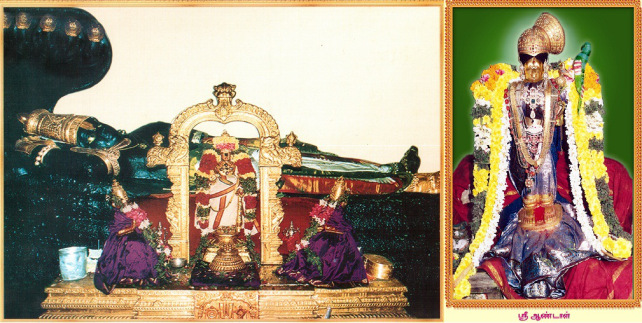
As per another legend, the land around Srivilliputhur was under the rule of Queen Malli who had two sons one of whom was Villi. One day, the Lord came in Villi’s dream and ordered him to found a city. Villi did so and the city became known by his name, Sri-villi-puthur. He then built a temple by installing the statue of Lord Vatapatrashaayi in it.
The temple has inscriptions from Chola, Pandya and Nayak rulers, spanning across various centuries from the 10th to 16th centuries. As per some accounts, the original structure was constructed by Tribuvana Chakravarthy Konerinmai Kondan Kulasekaran and the Andal temple by Barathi Rayar.
During the reign of Thirumalai Nayak (1623–1659) and Rani Mangammal (1689–1706), this city became very popular. Thirumalai Nayak renovated all the temples of this city.

He installed choultaries, temple tanks, paintings and golden towers inside the temple. The sculptures in the hall leading to the shrine of Andal were also built by him.[5]
From 1751 to 1756 CE, Srivilliputhur came under the rule of Nerkattumseval palayakkarar Puli thevar and was a maravarpalayam. Later the Fort of Srivilliputtur was ruled by Periyasami Thevar.
Then it fell into the hands of Mohammed Yousoof Khan. Until 1850, Sri Andal temple was under the care of the king of Trivancore.
The British ruled the country till India attained freedom in 1947. The temple’s gateway tower, 192 ft (59 m) tall and it is believed that this is the official symbol of the Government of Tamil Nadu (Sri Vatapatrasayi Temple Tower).
Sthala puranam
Mukunda Pattar and Padmavalli were a couple in Srivilliputhur, devoted to Lord Vishnu in the form of Vatapatrasayi (vata=banyan, patra=leaf, sayi=lying down). Their fifth child – Vishnuchittan – was also a devotee of the Lord, and used to prepare garlands for worship of the Lord at the temple. Once, Vishnuchittan won a contest and received a gold box by the grace of Lord Vishnu, who appeared on Garudan. The townfolk were astonished, and so Vishnuchittan sang a Pallandu which pleased Lord Vishnu. The Lord blessed him, and after this, Vishnuchittan became Periyazhvar.
One day when Periazhvar was gathering flowers in the garden, he found a girl child and took her home, as he and his wife were childless, and named her Kothai, who later came to be known by the local people as Andal. Kothai constantly dreamed of the Lord, and her only wish was to be married to Ranganatha Perumal. She even used to wear the garland prepared for the Lord, and ensure it was fit to offer to the Lord. On one occasion, Periazhvar found a human hair in the garland prepared for the Lord, and knowing it was Kothai’s started preparing another for the Lord. That night, Lord Vishnu appeared in his dream and insisted he would only accept the garland tried out by Kothai!
Kothai, now Andal, sang many pasurams on Perumal, and the day finally came when Lord Vishnu decided to get married to her and told Periazhvar to bring her to Srirangam. When he took Andal to Srirangam, she disappeared in the Kaveri river, as the Lord had taken her to be with him. Periazhvar requested the Lord to come to Srivilliputhur and get married to Andal, again. Accordingly, Ranganathar visited Srivilliputhur as Rangamannar (since he came dressed as a King) and married Andal.
Temple Structure
The Rajagopuram, the temple’s gateway tower has 11-tiers rising to a height of 194 ft. The tower was built by Periyazhwar with the prize money he obtained from winning a religious debate in the court of a Pandiya king. This awe-inspiring tower is the chosen emblem of Tamil Nadu. The temple has two sections – Andal temple located in the Southwest section and the Vatapatrashaayi temple in the Northeast section. The Andal shrine houses the image of Andal and Rangamannar. Garuda, who brought Lord Ranganatha the divine bridegroom, from Srirangam is also present in the same shrine. The second hall from the entrance towards the sanctum, houses sculptures of Mohini, Rama, Kamadeva, Ratidevi and many other deities.

The Vatapatrasayee Temple, is about 2000 years old and said to have existed long before the great Tamil Vaishnava scholar Periyazhwar's time. Unlike other temples, it a "Maadakkovil" and one has to climb a few steps to worship Lord Vatapatrasayee while the shrine of Sri Lakshmi Narasimha is on the ground floor.

The Vatapatrashaayi temple premise houses Lord Vatapatrashaayi in a reclining posture and his consorts Lakshmi (Sridevi) and Bhudevi. Sage Bhrigu stands near his head and sage Markandeya is near his feet. The banyan tree on whose leaf the Lord reclines is present behind Bhrigu. The hall leading to the sanctum has detailed teak wood carvings depicting Puranic events and Dashavataras. Near the dwajasthambam and bali peetam, there are shrines for Nammazhwar and Ramanujar on the left and Periyazhwar on the right. There is a shrine of Lord Lakshmi Narasimha facing the dwajasthamba.

The Lord’s image is a large and very colourful stucco image (made of brick and mortar), hence daily Thirumanjanam (sacred bath ) is not performed. Lord Vadabadrasayee was the Lord whom Periyalwar and Andal worshipped with such fervour. Images of Panchamurtis – Thumburu, Narada, Sanathkumara, Kinnara, Sun, Mithuna and Moon are present around the deity as well as representations of Villi and Puttan are seen at his feet.
Tiruppora Mandapam:
.jpg)
Tiruppora Mandapam is situated in the Nandavanam between Andal Shrine and Vadabadrasayee Shrine. It was here that Andal was found as a small child beneath Tulsi plant by Periyalwar. It is also believed that this mandapam was built by Periyalwar and the idol installed after his return from Srirangam where he handed over Andal in marriage to Ranga Mannar. . Inside the Nandavanam there is an idol of child Andal. By her side is the thulasi mantapam. The entire verses of divine Thiruppavai can been seen inscribed on marble in the Nandavanam.
 Andal Shrine:
Andal Temple is situated on the southwest side of the Temple Complex. 20 Pandha Mandapam is found in the entrance of Andal temple. Kalyana Mandapam is situated on the left side after Pandha Mandapam. There are shrines for Sri Rama and Srinivasa Perumal immediately after the Kalyana Mandapam. Dhwaja Sthambam can be found next. There is Mandapam called, Madhavi Mandapam after the Dhwaja Sthambam. This Mandapam houses lot of beautiful paintings depicting Lord Vishnu.

Next to it is the Mani Mandapam and then the Artha Mandapam and then the sanctum follows. The Sanctum houses the image of Andal and Ranga Mannar. In Srirangam, Lord Ranganathar holds a conch and discus in his hands, In Srivilliputhur, he holds a Dhandam-royal staff held by kings and is called as Ranga Mannar. A green parrot rest on Andal’s shoulder. This parrot is special in that it is freshly made by hand everyday using leaves and herbs.
Nandavanam:
The flower gardens (Nandavanam) in between these two areas are said to have been maintained by Periyalwar.
Andal Idol:
There is no separate shrine for Andal in the Temple premises. A separate Statue is kept for Sri Andal in the Nandavanam, where she was born, which is found on the North East direction .
Periyalwar Shrine:
Periyalwar Shrine is found on the North side of the temple and he is faced towards the south direction.
Festivals
Aadi Pooram, Adhyayana Utsavam, Vasantha Utsavam, Peria Perumal Bramhotsavam, Theppostavam and Andal Mannar Thirukalyanam are the important festivals celebrated in Srivilliputhur temple. Aadipooram festival, the birthday of Andal, celebrated during the Tamil month of Aadi (July – August), is the most prominent. During the festival, the presiding deities Sri Rangamannar and Goddess Andal are taken in decorated palanquins to the temple chariot. The festival marks the adoption of Andal, by Periyazhwar after he found her near the temple nandavanam.
The temple rituals are performed six times a day: Ushathkalam at 7 a.m., Kalasanthi at 8:00 a.m., Uchikalam at 12:00 p.m., Sayarakshai at 6:00 p.m., Irandamkalam at 7:00 p.m. and Ardha Jamam at 10:00 p.m.
Famous For:
Tulasi Garland
Sthana Powder (Turmeric Powder Made of natural herbs)
Palkova (Sweet Delicacy made of Milk)
How to Reach Srivilliputhur Temple?
By Air:
Madurai Airport is the nearest airport which is 70 km away
By Train:
Srivilliputhur Railway Station is the nearest Railway Station which is 2 km away
By Road:
Sriviliputhur Is Well Connected With Other Major Cities


